WTF is SEO (and how to do it right)
You can’t look into website marketing at all without hearing about SEO. Some people swear by it, others swear it’s dead. And others.. well… they just want to know WTF is SEO?!

You can’t look into website marketing at all without hearing about SEO. Some people swear by it, others swear it’s dead. And others.. well… they just want to know WTF it actually is!
This post is going to outline the fundamentals of Search Engine Optimisation (SEO), whether it’s important, and how to do it right.
If you’ve ever thought WTF when someone says SEO, read on!
ps. since I originally wrote this post, AI has become a thing. So I've added some stuff about how that factors into SEO.
So WTF is SEO anyway?
SEO stands for “Search Engine Optimisation” which is optimising your website to be found on Search Engines (and let’s be honest, by Search Engines I’m talking about Google).
See, Google wants to show its users relevant answers to whatever they’re looking for. If you get relevant answers when you search, then you’re less likely to look elsewhere for your answers. If the answers are garbage, you’ll stop using Google.
So Google has a set of criteria that it uses to decide when a website is relevant, and SEO is all about CRUSHING those criteria and getting yourself as high up in the rankings as you can get.
Why is SEO important?
Maybe you know exactly why SEO is important (feel free to skip this part).
But maybe you don’t. Maybe you’re thinking “Nick, why should I care about optimising for Google.”
Let’s have a think about this.
- You have a website.
- When you get visitors to your site, you get enquiries, which turn into clients, which turns into money.
- You start with some SEO and start to rise through the ranks on Google.
- When people search for your business type, you’re the first result.
- You get more visitors.
- That means more enquiries, more clients, more money.
75% of users never go past the first page of Google.
Being on page 2 (or worse) means 75% of people searching will NOT see your website.
Do you want to be invisible? Do you want to make LESS money?
No?
Well, that’s why SEO is important.
A history of bullshit
Back in ancient times (like 10+ years ago), Google used to decide if a website was relevant based on how many times the keyword was listed on the site, and how people linked to it. That means if you’re trying to rank for refrigerator repairs, you just need to have the words refrigerator repairs repeated a whole bunch throughout the site, then get more links to your site than your competition has.
See anything wrong with this?
Yeah, marketing people, being the geniuses (geniusi? genii?) they are, realised there was a huge opportunity here. They’d just “stuff” their sites full of keywords, and then get people in India and other countries to put links to their websites on tens of thousands of other (bullshit) sites.
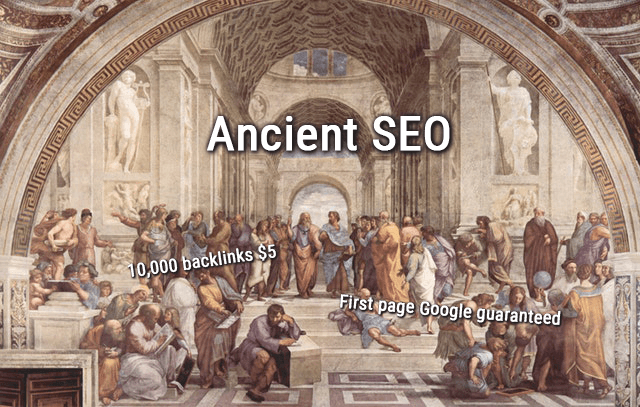
This meant a lot of crappy sites were hitting top spots on Google.
Remember how I said Google wants results to be relevant? Yeah, these sites that were hitting those top spots weren’t very relevant.
So Google implemented some changes to their “algorithm” (the magical formula that decides what matters) and BOOM! Suddenly everything changes.
In addition to changing how they value links, and protection against keyword “stuffing”, now they have this thing called RankBrain (which is kind of an early Artificial Intelligence) that measures how people interact with Google’s search results, and ranks websites based on that.
So how does that work? Well, let’s say you’re searching for refrigerator repairs, click the first link, see the site is garbage, go back and click the second and end up finding what you’re looking for. That tells RankBrain that the second link is worth more than the first, and it starts to move up the rankings.
That was wayyyyy back in 2015, and Google's gone all-in on AI since then. They've introduced a whole stack of systems they don’t even bother naming to figure out the meaning and intent behind what you type, not just the words themselves. Which matters more than ever (more on that in a bit).
So how do I optimise my website correctly for SEO?
So these days, SEO is made up of a few key things:
- On Page Optimisation
- Your Content
- Backlinks
1. On page SEO optimisation
This is a fancy way of saying all the content on your website needs to be set up correctly. Not only are we talking proper headings, page descriptions and image alt tags, but these days we need to include things like schema markups, internal linking, speed optimisation, and heaps more!
And when you think about RankBrain and the other AI systems they've got, you also need to consider elements like how appealing your page titles make the page sound, whether your website actually gives people the information they need, and whether your site is designed to keep people browsing.
2. Your content
In-depth, comprehensive, high-quality content is (supposedly) king for ranking.
Back in the day, Google looked at how often you used a specific keyword in your content in order to rank for it. They’d look at your website address, page titles, image tags, descriptions, and so on.
Now they look at the context in which it’s being used. That means it’s less about the content itself but more about how useful it is.
If you have a post that includes everything people are likely to look for in relation to refrigerator repairs, you’ll rank better than a post that has the word refrigerator repairs repeated throughout it.
Why? Because Google got smarter!
And good content leads to the next important factor.
3. Backlinks
Arguably the most important factor, and also the one that gets most people ripped off when it comes to SEO.
Backlinks are STILL gold in telling Google that your site matters (remember, backlinks are when other websites put a link to your site on theirs).
The thing is, those links need to be from quality websites, and they have to be natural (if you pay a website to give you links, Google might make you disappear).
So how do most people get ripped off with Backlinks?
Well, you know those shitty emails with horrific grammar you get landing constantly in your spam folder, offering to get you to the first page of Google? Amongst whatever else they do, they’re probably going to focus on building links to your site. They’re also probably going to get you those links from really shady websites, in a really unnatural way.
Even if someone tells you they’re going to get you links only from reputable sources, the question is how? It's not that easy to get someone to link to your site.
In reality, outside of adding your site to a number of directories (which we call citations), the most natural way you get links is by writing good quality content and then having people share and/or link to it on their own blogs or social media. There are a bunch of in-depth guides on how to build backlinks, and none of them include "go pay someone for a link." At least I hope not, I didn't go read every article about it.
There’s one thing for sure though, if your SEO strategy does include link building but does NOT include content creation you should definitely consider talking to someone about it. It might not be shady, but it definitely isn’t best practice.
But WTF about AI?
Since I first wrote this, SEO has been interrupted by AI entering the ring with a flying elbow.
You’ve probably noticed it when you search stuff on Google. Most of the time, Google will give you an AI-generated answer before you see anything else. That’s an AI Overview, and it’s made things kinda weird.
For some people, they're not even going to Google. They're asking ChatGPT or whatever their LLM of choice happens to be this month.
That means for a big chunk of searches now, people get an answer without clicking through to a site. Zero clicks. They read the AI summary and get on with their day. It's already brought clicks down on a lot of “informational” searches like your classic “what is / how do I / why does” stuff. Which funnily enough, covers this post. FML.
So… is SEO dead?
Nah, it's definitely evolved though.
The AIs don't pull answers out of thin air (well, except when they lie). They build their answers from sites that are ALREADY ranking near the top. So everything I’ve covered above still matters: you need good content, on-page SEO, backlinks, all of it.
The goal isn’t just to hit the top of Google anymore. It’s to also be the site the AI quotes (which people have been calling AEO or GEO).
So how do you actually win here? Same stuff that’s always worked:
- Answer real questions, clearly and directly. Just like people, AI loves a straight answer. The difference is the AI straight up steals your content.
- Prove you actually know your stuff. That means link things to real experience and expertise. Show the actual human behind the words. Google’s even got a framework for this now: E-E-A-T (Experience, Expertise, Authoritativeness, Trustworthiness).
- Don’t put out generic slop content. Google has spent the last few years trying to kill garbage content, adding more of it won't do you any favours.
If you want your content to rank, it needs to be good (obviously). But it also needs to be better than whatever else is already there. That means more relevant, more in depth, and more of an experienced take.
Conclusion
Here we go, pretty sure I covered everything kinda alright:
- WTF search engine optimisation actually is
- Why SEO matters
- Old school SEO and how things have changed
- How to optimise SEO correctly
- How to avoid getting ripped off with SEO
- And WTF AI is doing to mess with shit
If you're thinking about SEO for your site, holler at ya boy. I can check your site and let you know if it's worthwhile or not.